Mike's jailbreak
Stranger in a Strange LandMike’s jailbreak is the escape that brings him into view in St. Petersburg, where a television newscaster frames his reappearance as the climax of a criminal manhunt. Yet the broadcast’s language of a closing net and an angry public is undercut by Mike’s unhurried walk toward the cameras and crowd: the apparent fugitive chooses to meet the people watching him.
The Escape as a Media Spectacle
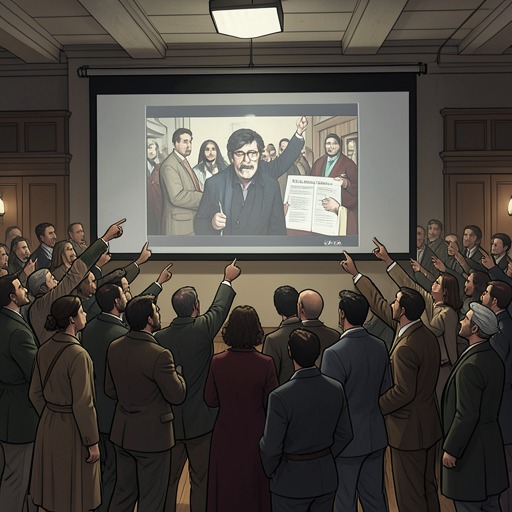
A mobile reporter for New World Networks announces that the man called the fake messiah or Man from Mars has emerged from his hotel hideout and apparently intends to surrender. The report says he had broken out of jail the previous day with high explosives smuggled in by his followers. It then speculates that the cordon around St. Petersburg may have proved too much for him, while immediately admitting that the reporter does not yet know what is happening. The broadcast thus packages uncertainty as suspense, turning a still-unfolding encounter into entertainment.
The commercial interruption sharpens that effect. Before the report resolves whether Mike is surrendering, viewers hear an advertisement for Elysian Fields, a restricted community built on reclaimed land, with each lot guaranteed to stand at least eighteen inches above mean high water. The shift from a supposed messiah trapped by a police cordon to a real-estate pitch makes the broadcast’s crisis part of the same attention-driven spectacle as its sales message.
The Crowd and the Pursuit
The reporter next describes the city as uniquely volatile. He says the crowd is angry because its laws have been flouted and security forces treated with contempt, and labels Mike’s followers fanatics who have caused turmoil to help their leader escape. His warnings that anything might happen encourage viewers to anticipate violence before the scene has shown any.
Instead, Mike walks toward the crowd without hurry. He is on the hotel steps while the people remain at least a hundred yards away, held off the grounds; Duke takes photographs and Mike waits for him to change lenses. As the cameras follow Mike, Anne and Duke fall behind. The newscaster calls the moment the blow-off, but Mike stops on the grass verge a few feet from the crowd and asks, “You called me?” The phrase makes the scene’s central reversal visible: the broadcast presents him as the object of a closing net, while his measured approach makes him appear to answer a summons.
Water, Kinship, and Belonging
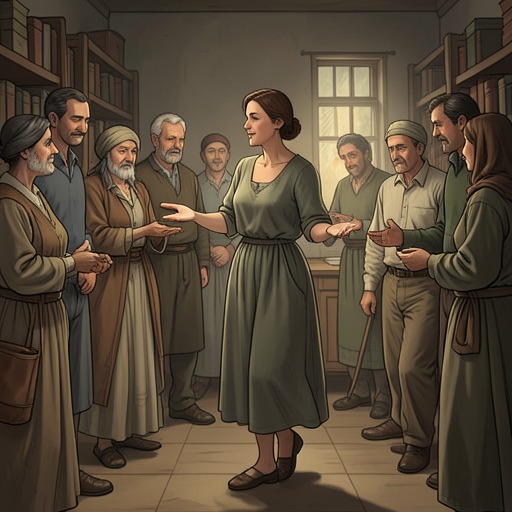
The public confrontation is framed by a contrasting practice of chosen kinship. In an earlier water-sharing scene, Mike sends a glass of water into the bathroom and returns it to Jill, who offers it to Patricia Paiwonski as a bond of trust and enduring partnership. Jill makes clear that Patricia can refuse without losing their friendship, and Mike emphasizes that she should not accept if her faith or conscience gives her any reason not to. Patricia chooses the rite; Jill drinks first, Mike then calls her his brother and offers Patricia the water of life. Membership here begins with invitation and consent, not force.
That same ethic has a communal setting in the Nest’s Innermost Temple, a circular room centered on a pool. Patricia explains to Ben Caxton that new brothers are received there and invites him to share water or swim; when he declines for the moment, she accepts that waiting is appropriate. The rite can be deferred, but the space makes its purpose plain: belonging is enacted by entering the water together.
The ceremony also has stages rather than a single threshold. Mike may invite someone to share water before the person reaches the Seventh Circle: Sam and Ruth, for example, entered the relationship while only in the Third Circle and later became a priest and priestess. Ordinarily, initiates proceed through the Eighth Circle and then into the Ninth Circle and the Nest itself, where the whole community attends their formal Sharing Water. The distinction between sharing water in daily life and the service that welcomes newcomers shows how an intimate bond becomes a lasting communal identity.
Initiation and the Limits of Witness
Sam and Ruth’s account gives the ritual’s emotional cost as well as its promise. After progressing to the Third Circle, they began to think in Martian, and Mike and Jill offered them water after a service. Ruth describes the resulting struggle with her own judgments and with the changes required of her; the couple continued through the inner circles with help because Mike wanted to bring them into the Nest’s safety and peace. She was still frightened by the prospect of merging herself with seven other people as their formal reception approached.
Inside the Innermost Temple, a spotlight found Ruth, the newcomers’ robes vanished, and the community called them to share the water of life. She stumbled into the pool and describes herself as never having come back up. Her memory turns a frightening passage into a welcome home, while her promise that Ben will have loving help makes initiation a process of communal support rather than a test of solitary readiness.
The scene of advancement into the Eighth Circle also exposes the difference between witnessing and participating. Ben sees Jill as Mother Eve in a vision of a Garden beside a serpent, then watches her open her arms to the candidates. Patricia leads him away before he can see the ceremony continue: Mike kisses the first woman in line, and her robe vanishes, followed by Jill kissing the first male candidate, whose robe also disappears. Patricia takes Ben around the long way to give the initiates time to reach the Eighth Circle Temple and return to the proper mood. The scene makes ritual transformation visible to the candidates but only partly available to an outside observer—much as the television broadcast can frame Mike’s approach without settling what his encounter with the crowd means.
Consequence and Significance
Mike’s escape culminates, in the supplied scene, not in an immediate arrest or surrender but in a deliberate approach to the people and cameras gathered outside the hotel. The report has already assigned him the roles of fugitive, fake messiah, and alleged antichrist; the distance he crosses on foot gives the encounter a different shape, without revealing its outcome. The episode’s juxtaposition with the Nest’s ceremonies places two forms of public meaning beside one another: a broadcast that converts uncertainty into accusation and spectacle, and a community whose bonds depend on trust, invitation, and shared participation.